







On this page
- Salesforce vs GoHighLevel at a glance
- Feature-by-feature checklist
- Salesforce and GoHighLevel in short: what we like and what we don't
- What each costs
- Sales pipelines and forecasting
- Marketing, funnels and messaging
- Automation
- Ease of setup and use
- Integrations and ecosystem
- Agencies and reselling
- Support and training
- Who should choose which
- A third option: DoubleScale
- So, which should you choose?
- Questions people ask
- More head-to-head comparisons
Salesforce and GoHighLevel both call themselves CRMs, but they are built for very different buyers. Salesforce is the enterprise sales platform: deep pipelines, forecasting, reporting and a huge app ecosystem, priced per user. GoHighLevel is an all-in-one marketing machine for agencies and local businesses: funnels, websites, calendars, email and SMS, priced per account with usage on top.
So the real question is not which is better, but which job you are hiring a CRM for. Prices below were checked on each vendor’s pricing page on October 20, 2026.
Editor’s note: Selling from a WordPress site? We also cover DoubleScale, a CRM with pipelines, email and booking inside WordPress for one flat price. We include it as a third option because many readers comparing Salesforce and GoHighLevel run their business on WordPress. Every price for the two brands comes from their own pricing pages.
Pick Salesforce if you run a sales team that needs serious forecasting, custom objects, territory and reporting depth, and you can fund per-user licences and implementation.
Pick GoHighLevel if you are an agency or local business that wants funnels, booking, email and SMS in one place, or you resell marketing to clients through sub-accounts.
Salesforce vs GoHighLevel at a glance
| Salesforce | GoHighLevel | DoubleScale | |
|---|---|---|---|
| Built for | Sales teams, mid-market and enterprise | Agencies and local businesses | Businesses on WordPress |
| Pricing model | Per user, per month | Per account, plus usage | Per site, unlimited users |
| Entry price | Starter Suite $25/user/mo | Starter $97/mo | Free; Pro $99/yr |
| Free option | Free Suite (2 users) | 14-day trial | Free plugin |
| Marketing tools | Separate Marketing Cloud products | Funnels, email, SMS, calendars built in | Email, SMS, WhatsApp, booking |
Vendor pricing pages, October 20, 2026.
Feature-by-feature checklist
| Feature | Salesforce | GoHighLevel |
|---|---|---|
| Visual sales pipeline | ✓ | ✓ |
| Products and price books | ✓ | — |
| Sales forecasting | ✓ | Basic |
| Territory management | Enterprise | — |
| Funnels and website builder | — | ✓ |
| Email campaigns | Basic / Marketing Cloud | ✓ |
| SMS and two-way texting | Add-on | ✓ |
| Booking calendars | Add-on | ✓ |
| Reputation management | — | ✓ |
| White-label reselling | — | Agency Pro |
| App marketplace | AppExchange (thousands) | Growing |
| Free plan | Free Suite (2 users) | — |
Salesforce and GoHighLevel in short: what we like and what we don't
Salesforce
Pros
- Deepest sales management and forecasting
- Customisable to almost any process
- Huge AppExchange ecosystem
- Excellent free training (Trailhead)
Cons
- Per-user pricing adds up quickly
- Marketing automation is a separate, costly product
- Usually needs an admin or partner beyond Starter
GoHighLevel
Pros
- Funnels, calendars, email, SMS and inbox in one account
- Flat price for unlimited users
- Built for agencies, with SaaS Mode reselling
- Fast to launch with snapshots
Cons
- Light sales reporting and forecasting
- Usage fees for email, SMS and calls
- Busy interface with a learning curve
- No free plan
What each costs
Salesforce lists a Free Suite for two users, Starter Suite at $25 per user a month and Pro Suite at $100 per user a month billed annually. The core Sales Cloud editions go further: Enterprise at $195, Unlimited (Advanced) at $395 and Max at $550 per user a month. Marketing automation is a separate product, with Account Engagement starting at $1,250 a month.
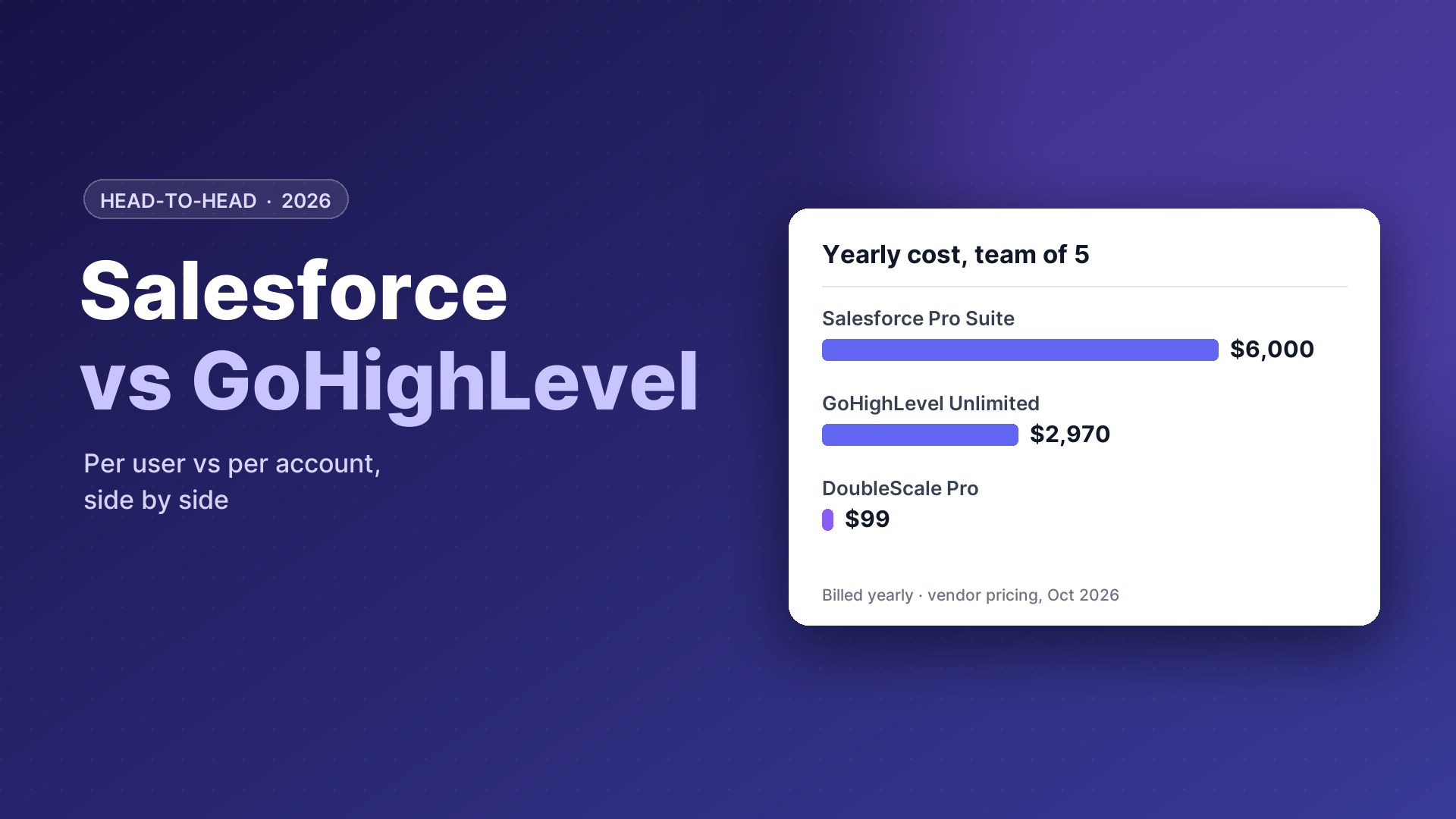
GoHighLevel is priced per account: Starter $97 a month (three sub-accounts), Unlimited $297 and Agency Pro $497 with SaaS Mode for reselling. Paying yearly costs $970, $2,970 or $4,970. Email, SMS and calls are billed by usage on top.
| Team of 5, billed yearly | Salesforce | GoHighLevel |
|---|---|---|
| Entry plan | $1,500 (Starter Suite) | $970 (Starter) |
| Growth plan | $6,000 (Pro Suite) | $2,970 (Unlimited) |
| Plus marketing | From $15,000 (Account Engagement) | Included (usage billed) |
Usage fees for email, SMS and calls are extra on GoHighLevel.
Salesforce grows with every user; GoHighLevel with usage and plan tier.
Our take: GoHighLevel has the edge for small teams.
Sales pipelines and forecasting
This is the area where the two products differ most, because it is the job Salesforce was built for and a secondary job for GoHighLevel.
Salesforce
Salesforce models the whole sales process: leads convert into accounts, contacts and opportunities; opportunities carry products, price books and quotes; and each stage can require fields or approvals before a deal moves on. Forecasting rolls deals up by rep, team, territory or product, and managers can adjust forecasts without touching the underlying data.
Higher editions add territory management, collaborative forecasting, guided selling and Einstein AI features such as opportunity scoring and activity capture. Reports and dashboards are flexible enough to answer almost any pipeline question, which is why Salesforce remains the default for sales organisations of 50 reps or more.
GoHighLevel
GoHighLevel has opportunities and visual pipelines with custom stages, values and owners. Deals are usually created automatically: a funnel opt-in, booked appointment or inbound call drops a new opportunity into the first stage, and workflows move it along.
What it lacks is depth for managing a sales team: there is no product catalogue with price books, forecasting is basic, and reporting focuses on marketing attribution and appointment outcomes rather than rep performance and quota.
Our take: Salesforce has the edge by a wide margin for sales management.
Marketing, funnels and messaging
Here the roles reverse. GoHighLevel is a marketing platform with a CRM attached; Salesforce is a CRM with marketing sold separately.
GoHighLevel
Every GoHighLevel account includes a funnel and website builder, forms and surveys, calendars, email and SMS campaigns, a unified inbox for SMS, email, Facebook, Instagram and Google Business messages, reputation management, and memberships or courses. Workflows tie them together: a lead fills a form, gets a text within seconds, books a call, and receives reminders, all without another tool.
Messaging is billed on usage through LC Email and LC Phone, so costs scale with volume rather than plan tier.
Salesforce
Salesforce Starter and Pro Suite include basic email outreach and simple campaigns. Serious marketing automation means adding Marketing Cloud Account Engagement (formerly Pardot, from $1,250 a month) for B2B or Marketing Cloud Engagement for B2C journeys. Both are powerful, but they are separate products with their own setup, licences and usually their own specialists.
| Marketing tool | Salesforce | GoHighLevel |
|---|---|---|
| Landing pages and funnels | Separate product | Included |
| Email campaigns | Basic in Starter/Pro; full in Marketing Cloud | Included (usage billed) |
| SMS | Marketing Cloud / partners | Included (usage billed) |
| Booking calendars | Partners / AppExchange | Included |
| Reputation management | Partners | Included |
Our take: GoHighLevel has the edge.
Looking elsewhere?Weighing GoHighLevel against others? See GoHighLevel alternatives.
Automation
Both platforms automate a lot, in different directions.
Salesforce Flow
Flow is a full process automation engine: record-triggered and scheduled flows, screen flows that guide users through steps, approvals and integrations with external systems. It can automate almost any internal business process, but building complex flows is admin work.
GoHighLevel Workflows
GoHighLevel workflows are aimed at lead nurturing: triggers such as form submitted, appointment booked or tag added, and actions such as send SMS, wait, move opportunity or notify a user. Templates and snapshots let agencies copy a working setup to a new client in minutes.
Our take: it depends on what you need: Salesforce for business processes, GoHighLevel for nurturing.
Ease of setup and use
GoHighLevel is quick to start with templates and snapshots, though its sheer number of features takes weeks to learn properly, and the interface changes often as features ship. Salesforce Starter is approachable, but anything beyond it usually needs an admin or implementation partner to configure objects, automation, permissions and reports. Partner projects commonly run into the thousands of dollars, which belongs in the real cost of Salesforce.
Our take: GoHighLevel has the edge.
Looking elsewhere?Comparing enterprise options? Read Salesforce alternatives for small business and HubSpot vs Salesforce.
Integrations and ecosystem
Salesforce’s AppExchange lists thousands of apps, and almost every B2B software vendor builds a Salesforce connector first. GoHighLevel has a growing marketplace, native connections for Stripe, Google, Facebook and QuickBooks, Zapier support and an API on its higher plans. For a large company with many systems, Salesforce integrates more easily; for a small business, GoHighLevel’s built-in tools reduce how many integrations are needed in the first place.
Our take: Salesforce has the edge.
Agencies and reselling
GoHighLevel is designed for agencies: each client gets a sub-account, snapshots copy funnels and workflows between them, and Agency Pro adds SaaS Mode so you can resell the platform under your own brand, with your own pricing and a white-label mobile app. Salesforce has partner programmes and multi-org options, but nothing comparable for reselling marketing to small clients.
Our take: GoHighLevel has the edge.
Support and training
Salesforce includes standard support with every licence and sells faster, 24/7 support as a paid plan; its free Trailhead learning platform is one of the best training resources in software. GoHighLevel offers chat, phone and email support plus a large community and onboarding calls, and a big ecosystem of agencies selling setup services.
Our take: the two are evenly matched here, so this should not decide your choice.
Who should choose which
Choose Salesforce if
- You run a sales team that needs forecasting, territories and approvals
- You need custom objects and enterprise reporting
- Other systems in your company already connect to Salesforce
Choose GoHighLevel if
- You are an agency managing marketing for clients
- You are a local business that wants funnels, booking and texting in one place
- You want to resell software under your own brand
Runs your entire business
A third option: DoubleScale
If your website runs on WordPress, DoubleScale gives your whole team a CRM with pipelines, email, booking, invoices and a helpdesk for one flat price per site.
The free plugin covers contacts, email campaigns through your own provider, visual automations, booking pages, proposals, invoices and a helpdesk. Paid plans (from $99 a year per site, any number of users) add deal pipelines with forecasts, all 32 automation triggers, email sequences, lead scoring, contracts, SMS and WhatsApp.
Modular by design. Turn on only the modules you need from one Control Modules panel; everything else stays out of your way.
- Email campaigns
- Automations
- Sales pipelines
- Proposals & invoices
- Contracts
- Booking
- Helpdesk
- Forms
- Projects
- Tasks
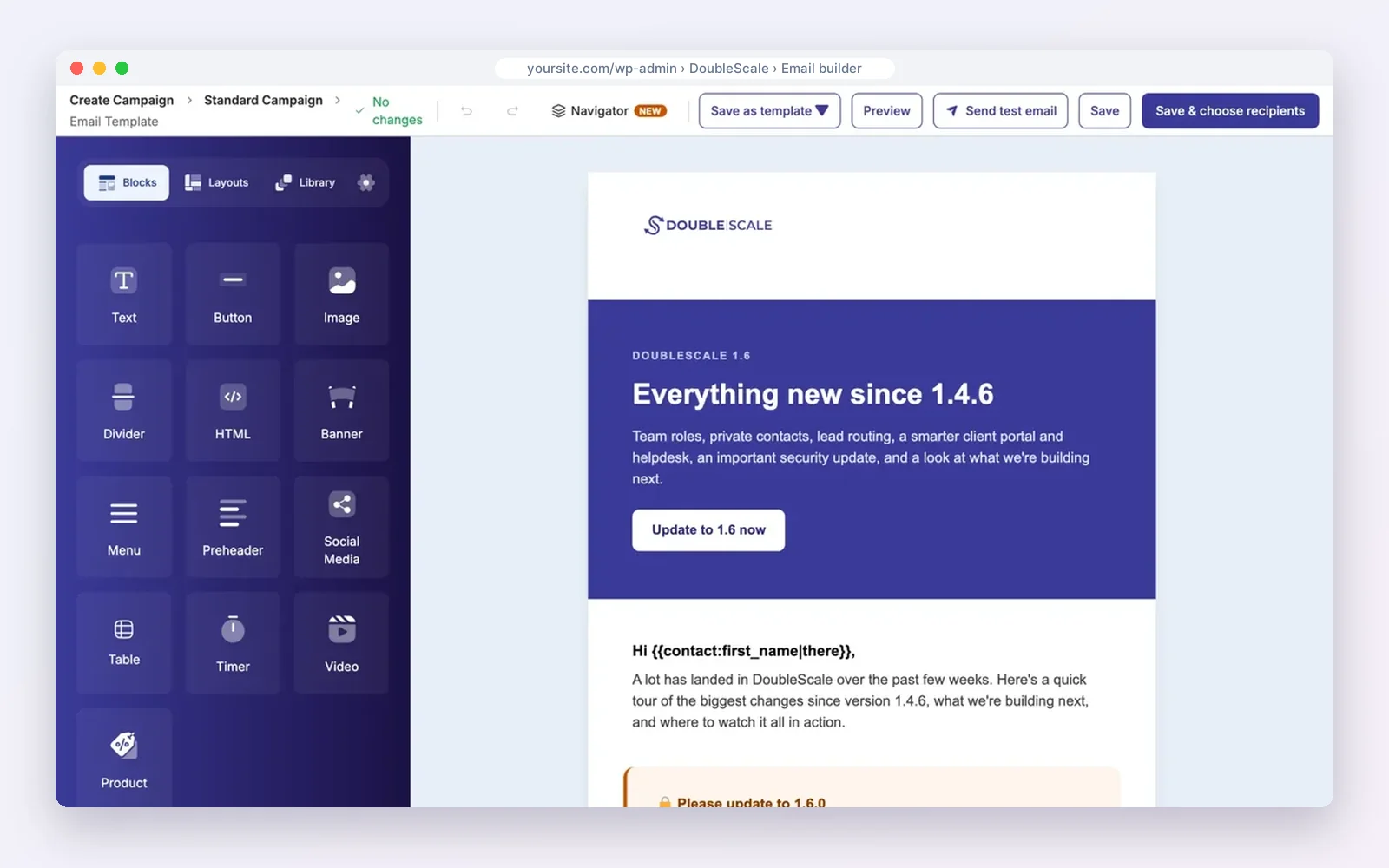
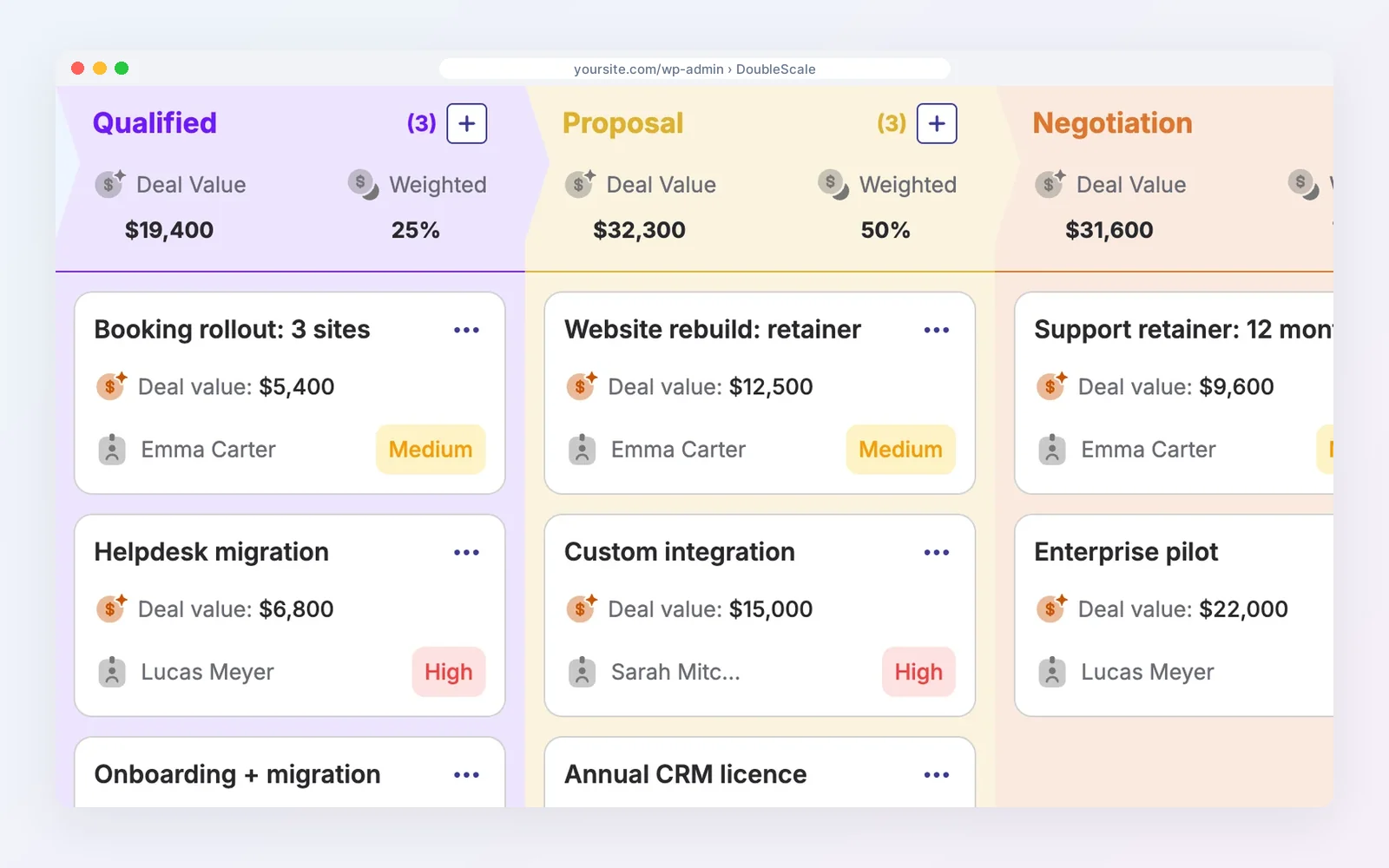
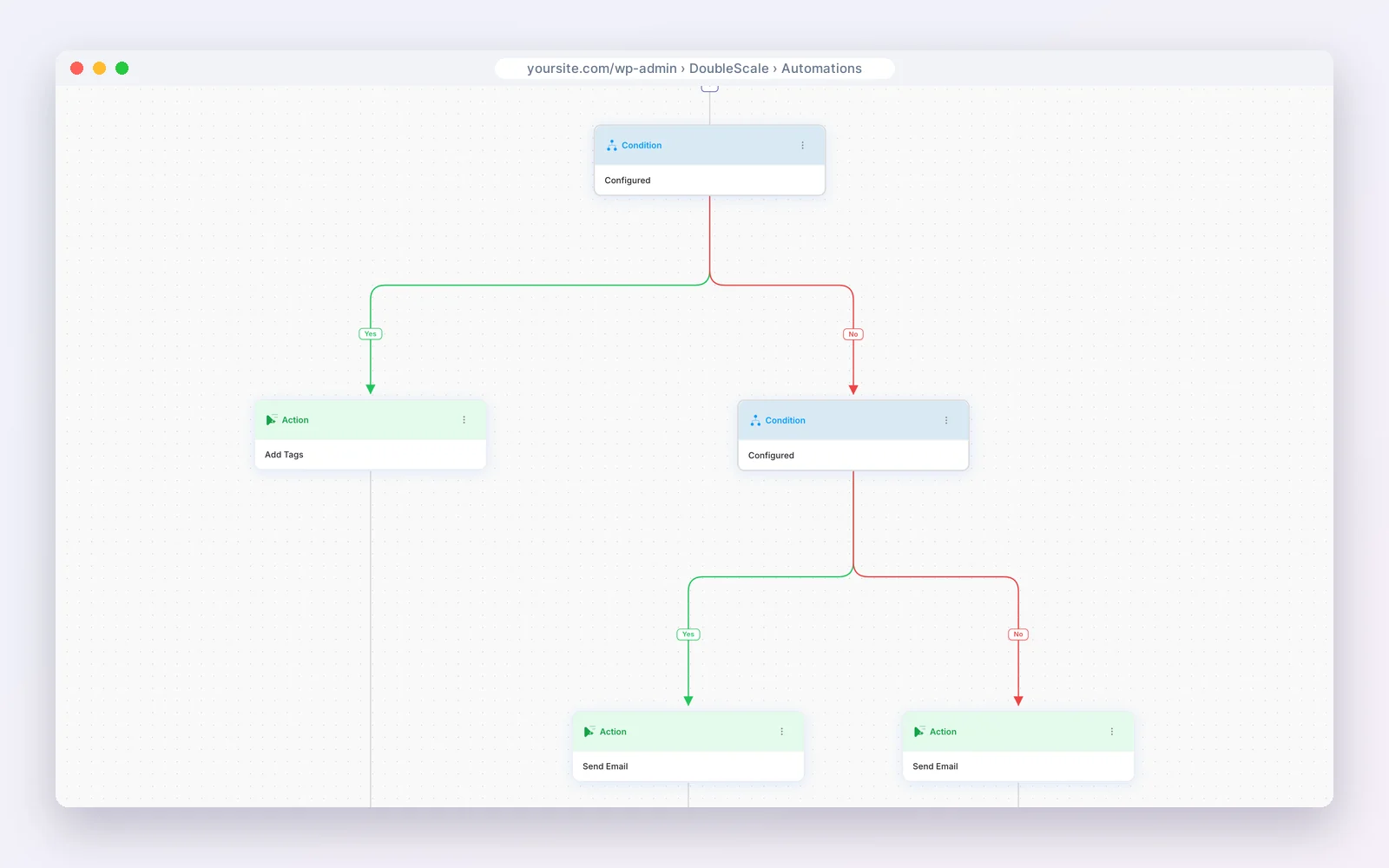
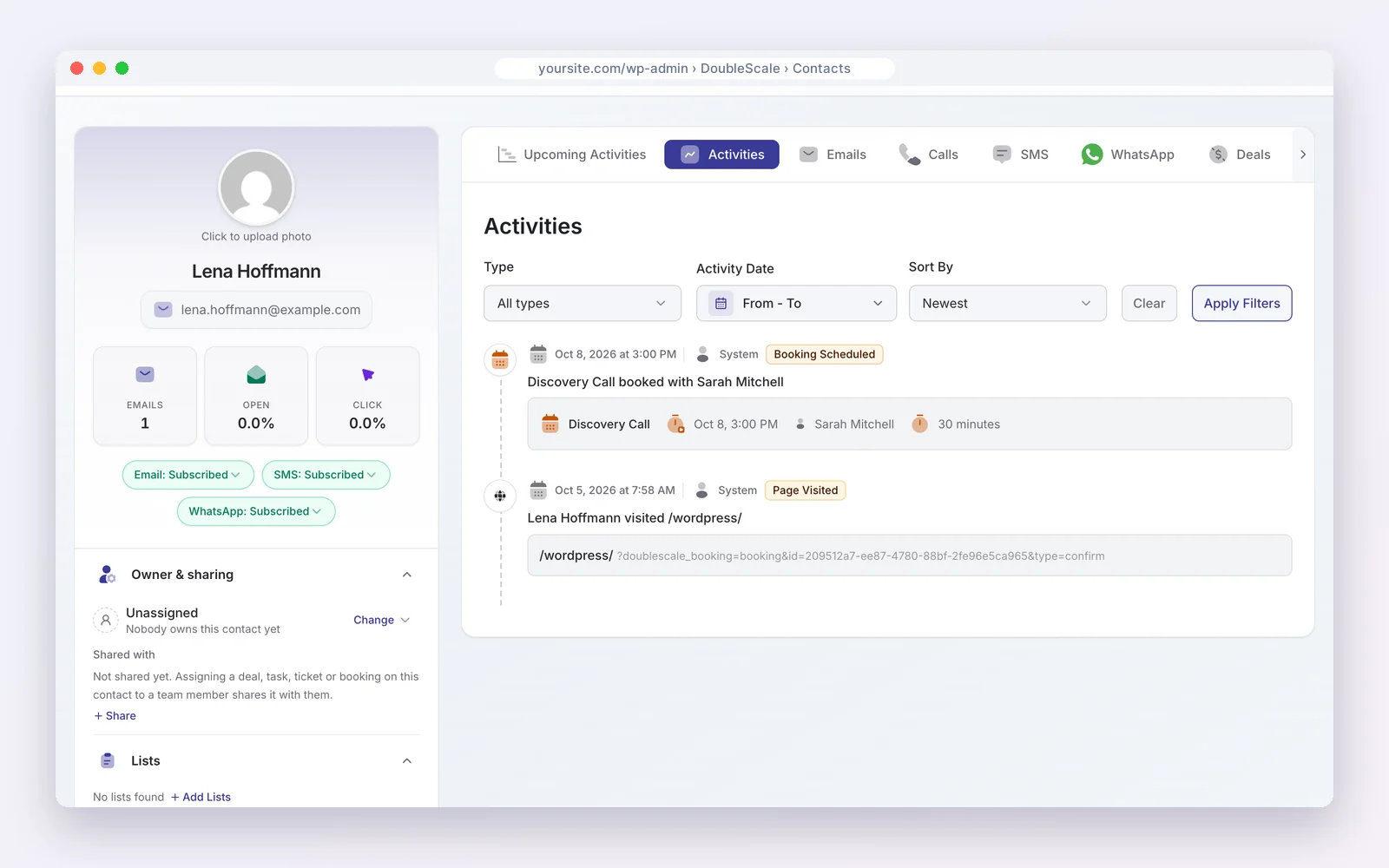
Free on WordPress.org · Unlimited contacts · Pro from $99/yr per site
DoubleScale is the better pick if…
- You sell from a WordPress site and want no per-seat pricing.
- You want quotes, invoices and support on the same record as the deal.
- You want your customer data on your own server.
Stick with the big platforms if…
- You need an enterprise platform with a large app marketplace.
- Your business does not run on WordPress.
- You need built-in calling or AI forecasting.
See also DoubleScale pipelines and GoHighLevel vs HubSpot.
Disclosure: we make DoubleScale. The screens above are real, and every price for the other tools comes from their own pricing pages.
So, which should you choose?
| Your situation | Choose |
|---|---|
| Sales organisation with complex forecasting | Salesforce |
| Agency reselling marketing to clients | GoHighLevel |
| Local business wanting funnels, booking and SMS | GoHighLevel |
| Enterprise reporting and integrations | Salesforce |
| Business on WordPress, flat price | DoubleScale |
How we compared: every price was read on the vendor’s own pricing page on October 20, 2026 (USD). Prices change often, so check the vendor’s page before you buy.
Questions people ask
Is GoHighLevel a replacement for Salesforce?
For agencies and small businesses focused on lead capture and nurturing, often yes. For sales organisations that need forecasting, territories and deep reporting, no.
Which is cheaper, Salesforce or GoHighLevel?
For a small team, GoHighLevel: $970 a year on Starter against $1,500 for five users on Salesforce Starter Suite, or $6,000 on Pro Suite. GoHighLevel adds usage fees for email, SMS and calls.
Does Salesforce have funnels like GoHighLevel?
Not in the core CRM. Landing pages and marketing automation come from separate Salesforce marketing products.
Does GoHighLevel have a free plan?
No, it offers a 14-day trial. Salesforce lists a Free Suite for two users.
More head-to-head comparisons
- ActiveCampaign vs HubSpot
- GoHighLevel vs HubSpot
- HubSpot vs Salesforce
- Pipedrive vs HubSpot
- Zoho CRM vs HubSpot
- GoHighLevel vs Pipedrive
- Pipedrive vs Salesforce
- Zoho CRM vs Salesforce
- Pipedrive vs Zoho CRM
One flat price per site, with your data on your own server.
Get our guides first on GoogleAdd DoubleScale as a preferred source and our articles show up more often in your Top Stories.

Mohamed Magdy, Founder & CEO, DoubleScale
Mohamed Magdy is the founder and CEO of DoubleScale, the all-in-one CRM for WordPress. He writes about CRM, email marketing and automation for WordPress businesses.
Practical CRM tips, once a month
Guides on growing with WordPress: lead capture, email marketing, automations and sales. No spam, unsubscribe anytime.