







On this page
- Zoho CRM vs Salesforce at a glance
- Feature-by-feature checklist
- Zoho CRM and Salesforce in short: what we like and what we don't
- What each costs
- Core CRM features
- Customisation and automation
- Ecosystem and the wider suite
- AI and analytics
- Ease of use and setup
- Support
- Who should choose which
- A third option: DoubleScale
- So, which should you choose?
- Questions people ask
- More head-to-head comparisons
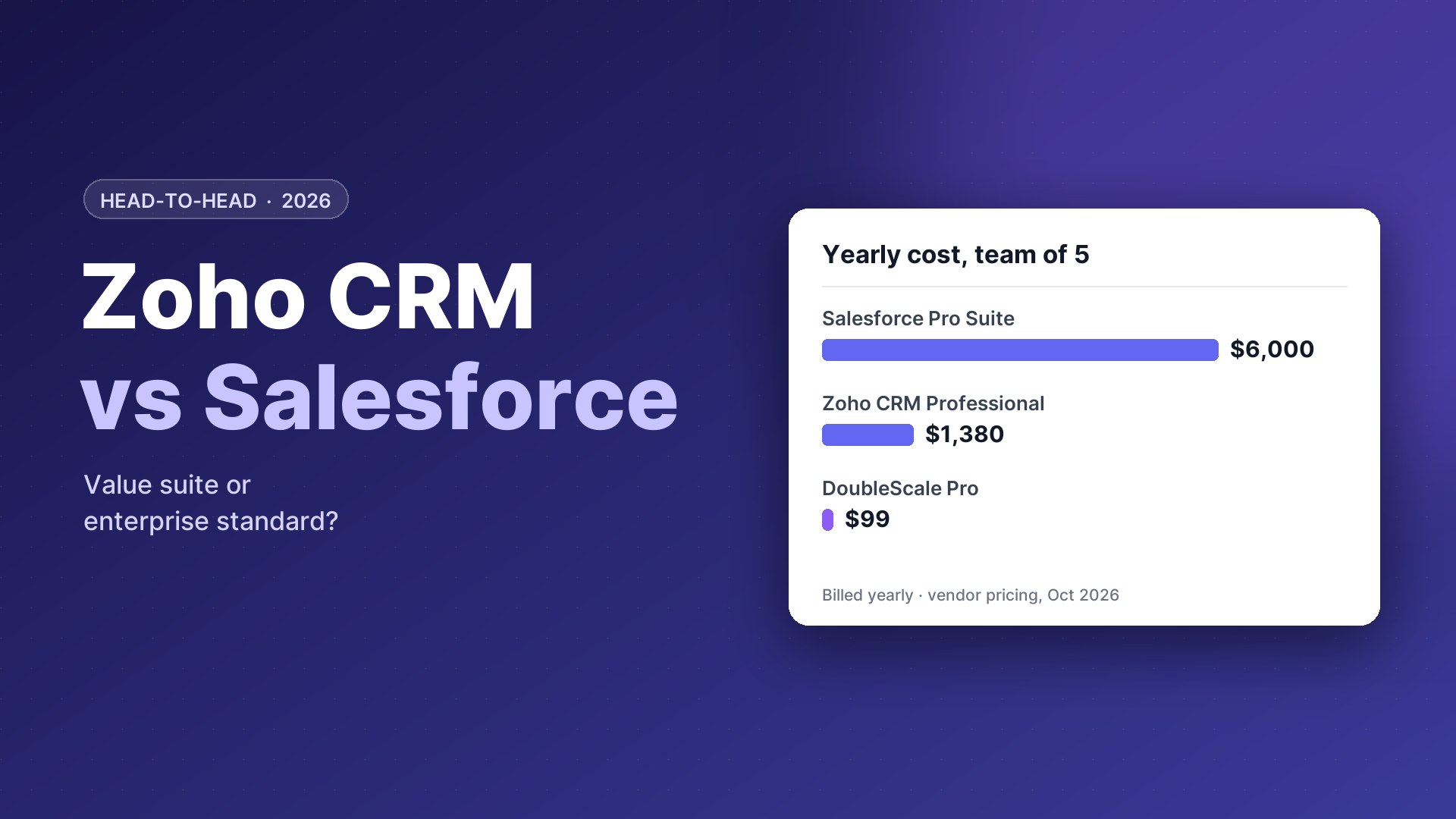
Zoho CRM is often described as the value alternative to Salesforce, and with good reason: it covers leads, deals, automation, forecasting and customisation at a fraction of the per-user price, and sits inside a suite of 50-plus business apps. Salesforce remains the enterprise standard for depth, ecosystem and scale.
Here is how they compare. Prices were checked on each vendor’s page on October 20, 2026; Zoho prices are USD from its own pricing data.
Editor’s note: On WordPress? We also cover DoubleScale, which puts CRM, email, booking and invoices inside your site. We include it as a third option because many readers comparing Zoho CRM and Salesforce run their business on WordPress. Every price for the two brands comes from their own pricing pages.
Pick Zoho CRM if you want strong CRM features and customisation on a budget, or you want CRM, email, helpdesk and finance from one vendor.
Pick Salesforce if you need the deepest platform, the largest app ecosystem and enterprise-grade reporting and governance.
Zoho CRM vs Salesforce at a glance
| Zoho CRM | Salesforce | DoubleScale | |
|---|---|---|---|
| Free plan | Yes, 3 users | Free Suite, 2 users | Free plugin |
| Entry paid | Standard $14/user/mo yearly | Starter Suite $25/user/mo | Pro $99/yr per site |
| Mid tier | Professional $23/user/mo | Pro Suite $100/user/mo | Unlimited users |
| Suite | Zoho One / CRM Plus | Sales, Service, Marketing Clouds | Modules you switch on |
| Ecosystem | Zoho apps + Marketplace | AppExchange | WordPress plugins |
Vendor pricing pages, October 20, 2026.
Feature-by-feature checklist
| Feature | Zoho CRM | Salesforce |
|---|---|---|
| Free plan | 3 users | Free Suite (2 users) |
| Workflow automation | ✓ | ✓ |
| Guided processes | Blueprint | Path / Flow |
| Quotes and invoices | Professional | Pro Suite |
| Territory management | Enterprise | Enterprise |
| Custom modules / objects | ✓ | ✓ |
| AI assistant | Zia | Einstein / Agentforce |
| Sandbox | Enterprise | Enterprise |
| Built-in suite apps | Zoho One (45+ apps) | Separate clouds |
| Marketplace | Zoho Marketplace | AppExchange (thousands) |
| Mobile app | ✓ | ✓ |
Zoho CRM and Salesforce in short: what we like and what we don't
Zoho CRM
Pros
- Free for 3 users, low per-user prices
- Rich features on lower plans
- Native suite of business apps
- Easier to self-configure
Cons
- Busy interface
- Premium support costs extra
- Smaller third-party ecosystem
Salesforce
Pros
- Deepest platform and automation
- Largest ecosystem and talent pool
- Strong AI and analytics
- Enterprise governance
Cons
- Roughly four times the cost at mid tier
- Admin or partner usually needed
- Each extra cloud is a separate purchase
What each costs
Zoho CRM is free for up to three users. Paid editions cost $14, $23, $40 and $52 per user a month billed yearly ($20, $35, $50 and $65 monthly). CRM Plus, which adds marketing, support and analytics apps, costs $57 per user a month yearly.
Salesforce lists Free Suite (two users), Starter Suite $25 and Pro Suite $100 per user a month billed annually, then Enterprise $195, Unlimited $395 and Max $550.
| Team of 5, billed yearly | Zoho CRM | Salesforce |
|---|---|---|
| Entry | $840 (Standard) | $1,500 (Starter Suite) |
| Mid tier | $1,380 (Professional) | $6,000 (Pro Suite) |
| Advanced | $2,400 (Enterprise) | $11,700 (Enterprise) |
Before add-ons and implementation.
Salesforce costs roughly four times Zoho at the mid tier.
Our take: Zoho CRM has the edge.
Core CRM features
On paper, the feature lists overlap heavily: leads, contacts, accounts, deals, activities, email integration, workflows, assignment rules, reports and dashboards. The differences are in depth and in which plan unlocks what.
Zoho CRM
Zoho packs a lot into its lower plans. Standard includes workflows, scoring rules and custom dashboards; Professional adds Blueprint (guided processes that make reps complete steps in order), inventory management with quotes and invoices, and validation rules. Enterprise adds the Zia AI assistant, territory management, sandbox and Canvas for redesigning record layouts.
Salesforce
Salesforce Starter covers the essentials with a simple setup, and Pro Suite adds quoting, forecasting and more automation. Enterprise and above unlock the full platform: complex automation with Flow, advanced permissions, territory management and API access for integrations.
Our take: Zoho CRM has the edge on features per dollar.
Customisation and automation
Both platforms let you add custom modules or objects, fields, layouts and automation. Salesforce’s data model, Flow automation and developer platform scale further and support very complex enterprises. Zoho’s Blueprint, Deluge scripting language and Canvas give small and mid-sized companies a lot of control without hiring specialists.
Our take: Salesforce has the edge for depth.
Ecosystem and the wider suite
The two take very different approaches to everything beyond the CRM.
Zoho
Zoho’s advantage is its own suite. CRM, Campaigns, Desk, Books, Projects, Analytics, SalesIQ and more share data natively, and Zoho One bundles 45-plus apps per employee. A small company can run most of its operations on one vendor without third-party connectors.
Salesforce
Salesforce’s AppExchange and partner network are unmatched: almost any integration exists, and there is a large pool of consultants and admins to hire. Its own clouds (Service, Marketing, Commerce) are powerful but each is a separate, significant purchase.
Our take: Salesforce has the edge for third-party ecosystem; Zoho for an all-in-one suite.
Looking elsewhere?Looking at other options? See Salesforce alternatives and Zoho CRM vs HubSpot.
AI and analytics
Zia, Zoho’s assistant, predicts deal closures, suggests the best time to contact leads, detects anomalies in trends and answers questions in plain language on Enterprise and Ultimate. Salesforce Einstein and Agentforce offer scoring, forecasting, generative summaries and autonomous agents, generally more advanced and generally more expensive. For deep analytics, Zoho Analytics and Salesforce’s CRM Analytics (Tableau) are both add-ons.
Our take: Salesforce has the edge.
Ease of use and setup
Zoho is faster and cheaper to set up for a small team, and many companies configure it themselves. Its interface is dense and settings are spread across many screens, so expect some learning. Salesforce usually needs an admin or partner as you grow beyond Starter; in exchange, you get a platform many staff already know from previous jobs.
Our take: Zoho CRM has the edge.
Support
Zoho includes basic email support on all plans and sells premium support with phone and faster response as a percentage of the licence. Salesforce includes standard support and sells Premier and Signature success plans. Both have large communities; Salesforce’s Trailhead is the stronger free training resource.
Our take: the two are evenly matched here, so this should not decide your choice.
Who should choose which
Choose Zoho CRM if
- You want full CRM features on a small budget
- You want CRM, helpdesk, email and finance from one vendor
- You will configure the CRM yourself
Choose Salesforce if
- You run a large or complex sales organisation
- You need specific AppExchange integrations
- You want the industry-standard platform
Runs your entire business
A third option: DoubleScale
If your website runs on WordPress, DoubleScale gives your whole team a CRM with pipelines, email, booking, invoices and a helpdesk for one flat price per site.
The free plugin covers contacts, email campaigns through your own provider, visual automations, booking pages, proposals, invoices and a helpdesk. Paid plans (from $99 a year per site, any number of users) add deal pipelines with forecasts, all 32 automation triggers, email sequences, lead scoring, contracts, SMS and WhatsApp.
Modular by design. Turn on only the modules you need from one Control Modules panel; everything else stays out of your way.
- Email campaigns
- Automations
- Sales pipelines
- Proposals & invoices
- Contracts
- Booking
- Helpdesk
- Forms
- Projects
- Tasks
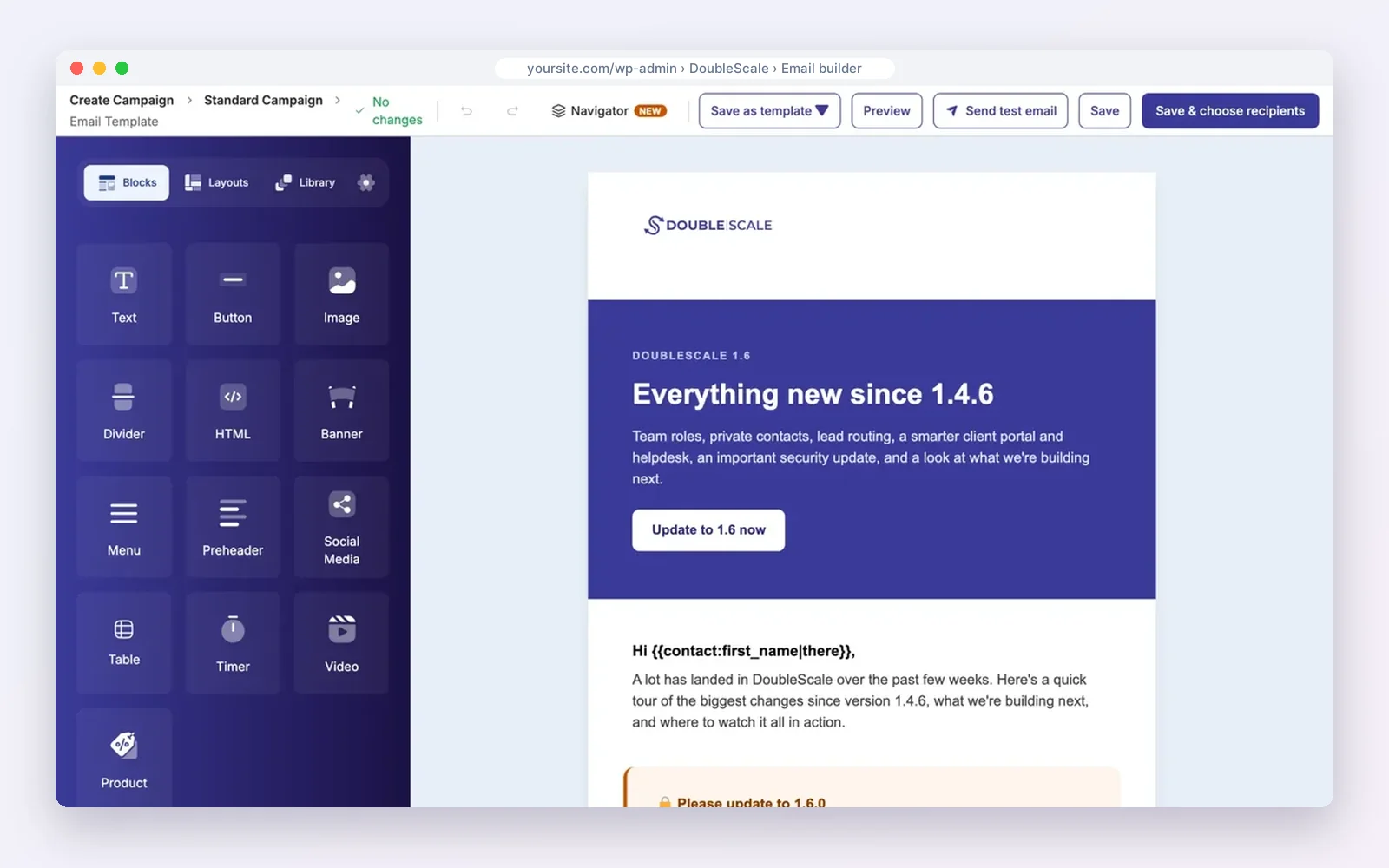
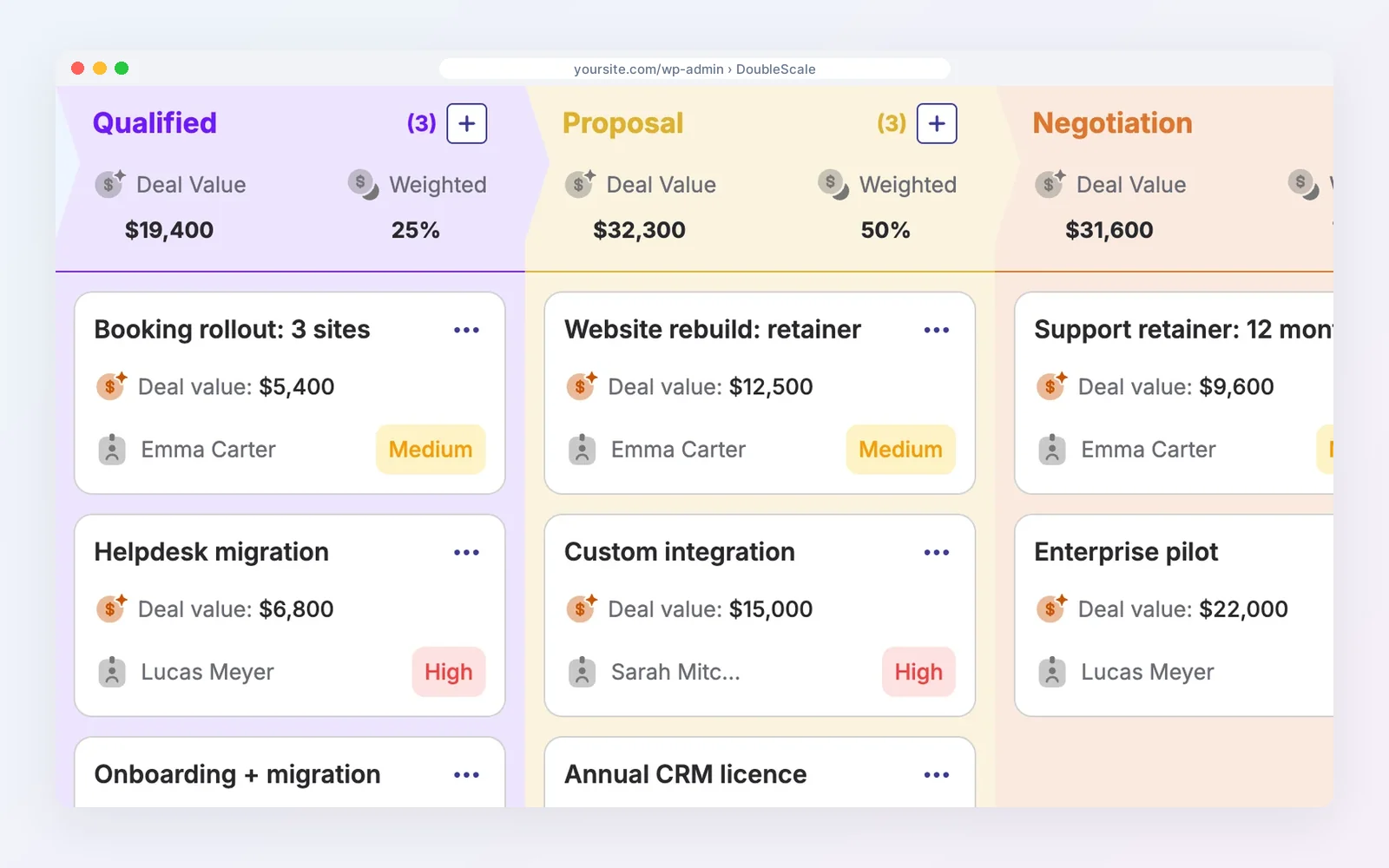
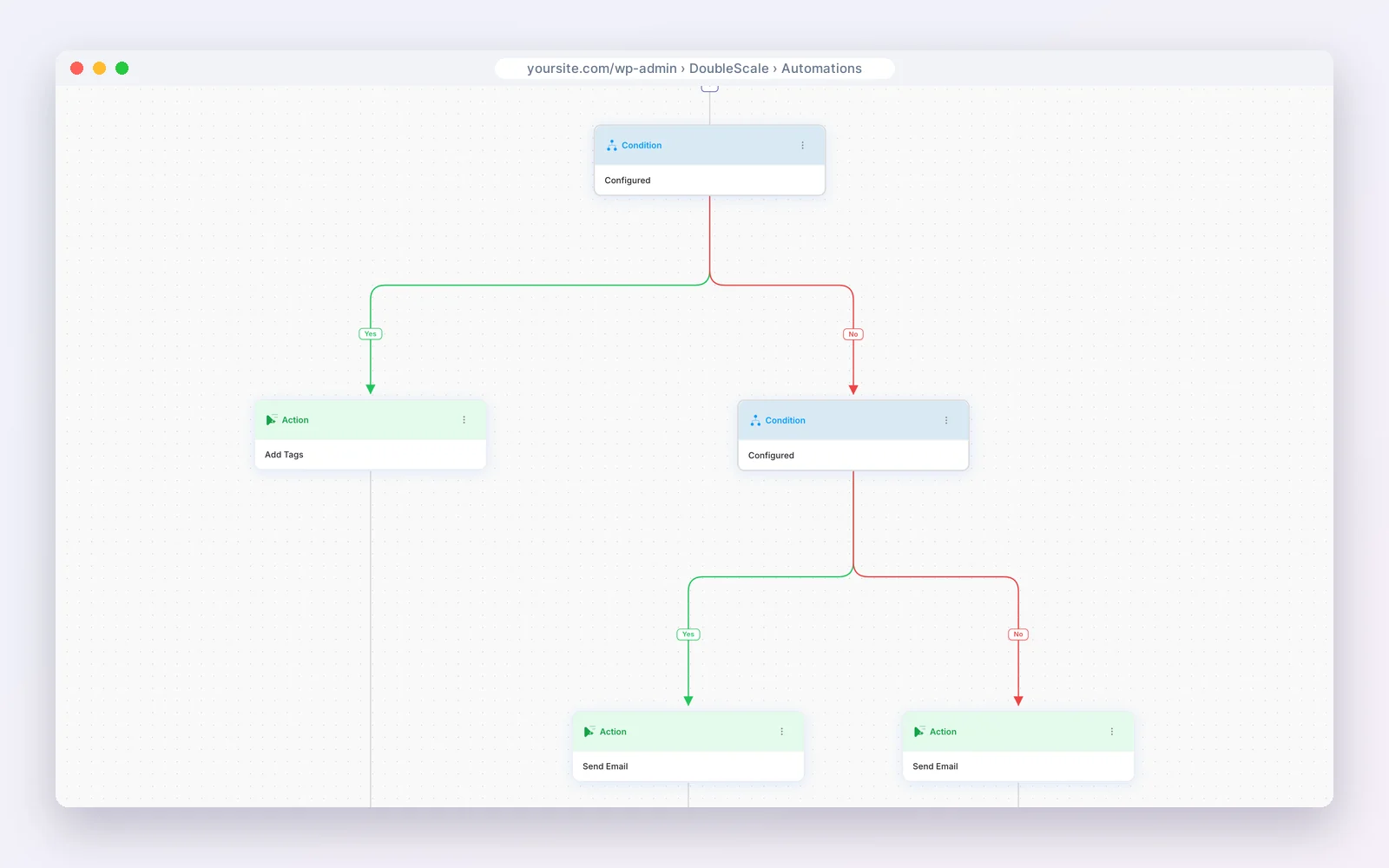
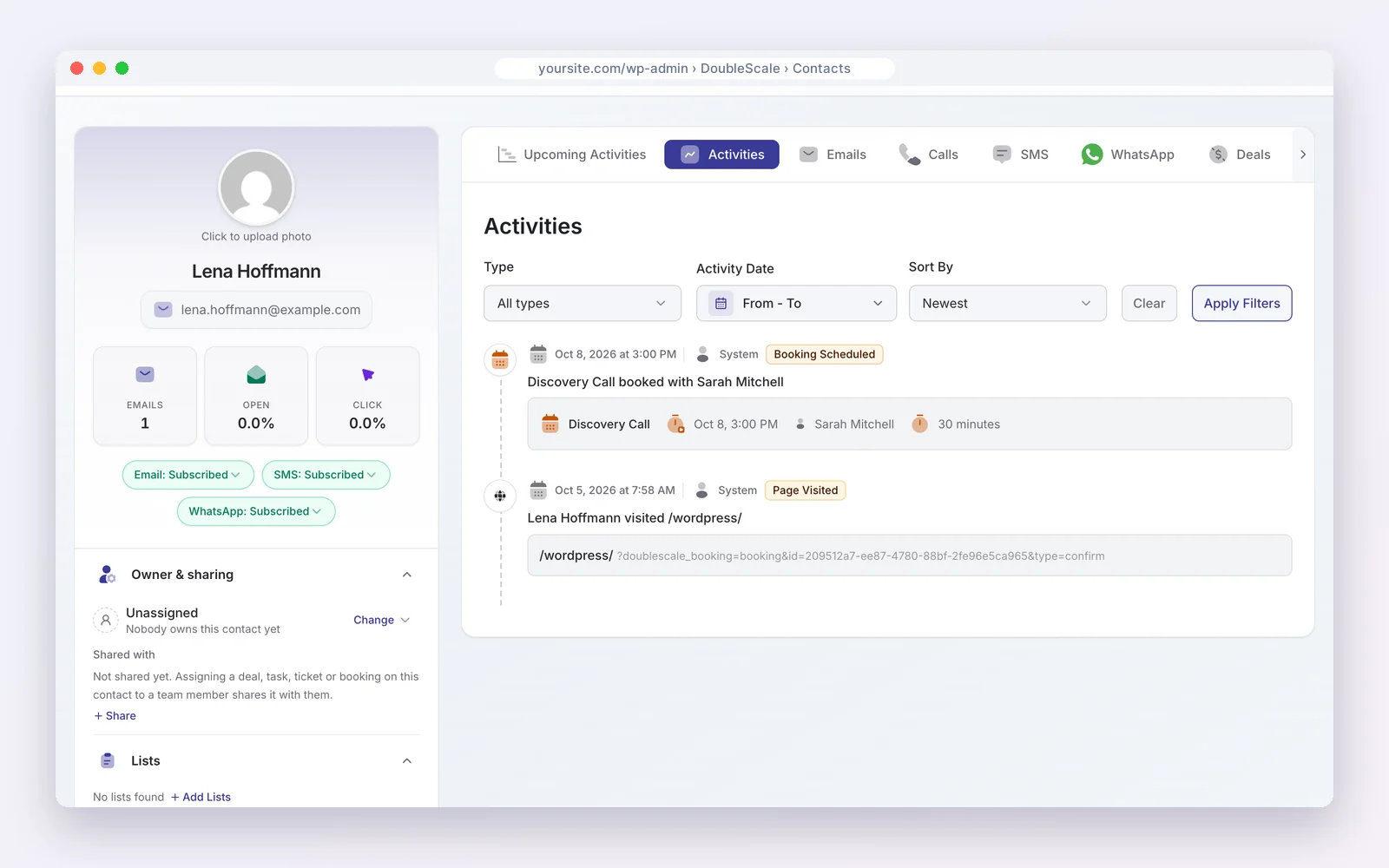
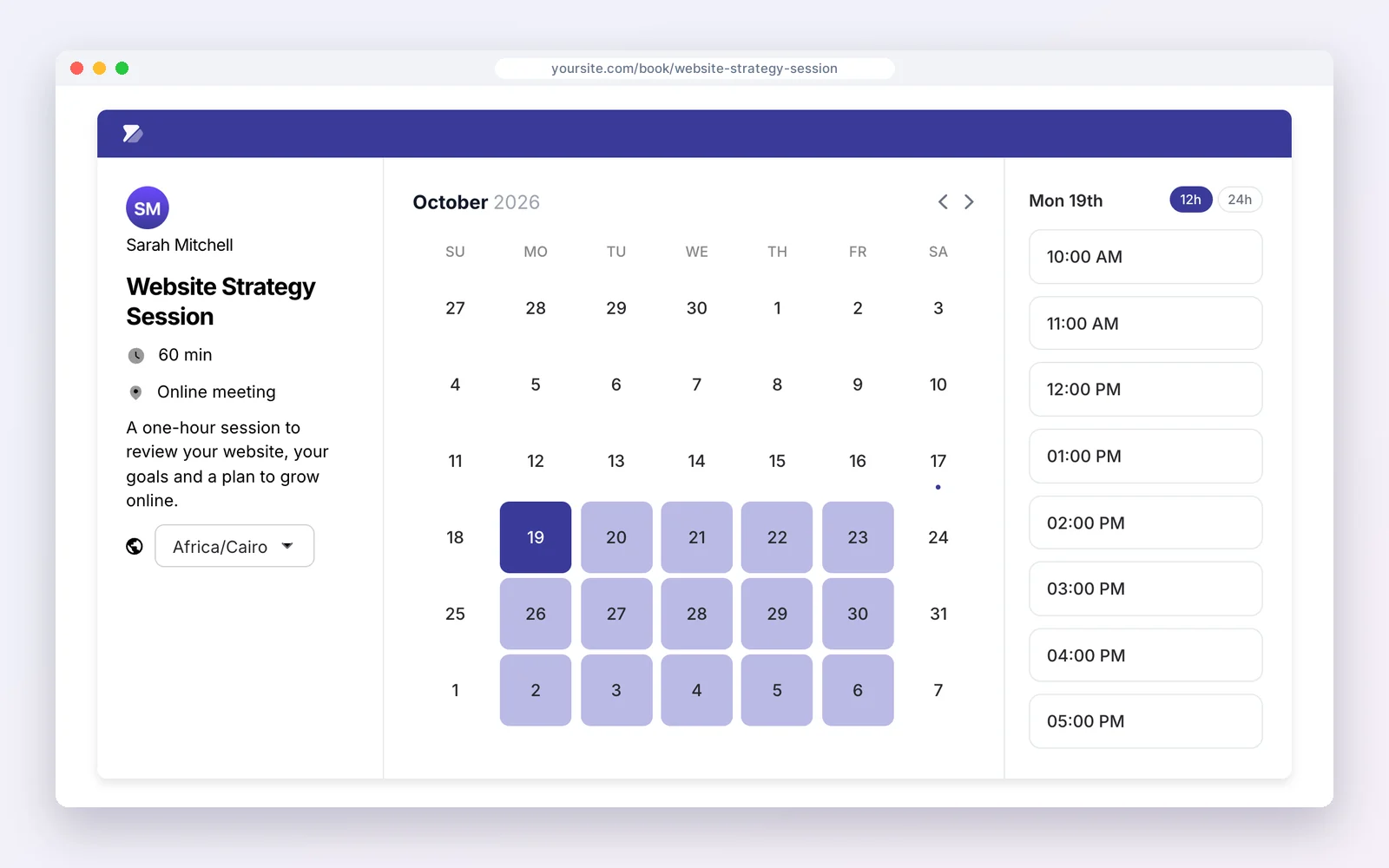
Free on WordPress.org · Unlimited contacts · Pro from $99/yr per site
DoubleScale is the better pick if…
- You sell from a WordPress site and want no per-seat pricing.
- You want quotes, invoices and support on the same record as the deal.
- You want your customer data on your own server.
Stick with the big platforms if…
- You need an enterprise platform with a large app marketplace.
- Your business does not run on WordPress.
- You need built-in calling or AI forecasting.
See also DoubleScale features and HubSpot vs Salesforce.
Disclosure: we make DoubleScale. The screens above are real, and every price for the other tools comes from their own pricing pages.
So, which should you choose?
| Your situation | Choose |
|---|---|
| Budget-conscious team wanting full CRM features | Zoho CRM |
| Enterprise with complex processes | Salesforce |
| One vendor for CRM, email, desk and finance | Zoho (CRM Plus / Zoho One) |
| Largest app ecosystem | Salesforce |
| Business on WordPress, flat price | DoubleScale |
How we compared: every price was read on the vendor’s own pricing page on October 20, 2026 (USD). Prices change often, so check the vendor’s page before you buy.
Questions people ask
Is Zoho CRM as good as Salesforce?
For most small and mid-sized teams, Zoho covers the same core features at a much lower price. Salesforce is deeper for complex, large-scale use.
How much cheaper is Zoho than Salesforce?
For five users, Zoho Professional is $1,380 a year against $6,000 for Salesforce Pro Suite.
Do Zoho and Salesforce have free plans?
Zoho CRM is free for three users; Salesforce lists a Free Suite for two.
Can I migrate from Salesforce to Zoho?
Yes; Zoho provides migration tools, and both export to CSV.
More head-to-head comparisons
- ActiveCampaign vs HubSpot
- GoHighLevel vs HubSpot
- HubSpot vs Salesforce
- Pipedrive vs HubSpot
- Zoho CRM vs HubSpot
- Salesforce vs GoHighLevel
- GoHighLevel vs Pipedrive
- Pipedrive vs Salesforce
- Pipedrive vs Zoho CRM
One flat price per site, with no per-user fees.
Get our guides first on GoogleAdd DoubleScale as a preferred source and our articles show up more often in your Top Stories.

Mohamed Magdy, Founder & CEO, DoubleScale
Mohamed Magdy is the founder and CEO of DoubleScale, the all-in-one CRM for WordPress. He writes about CRM, email marketing and automation for WordPress businesses.
Practical CRM tips, once a month
Guides on growing with WordPress: lead capture, email marketing, automations and sales. No spam, unsubscribe anytime.